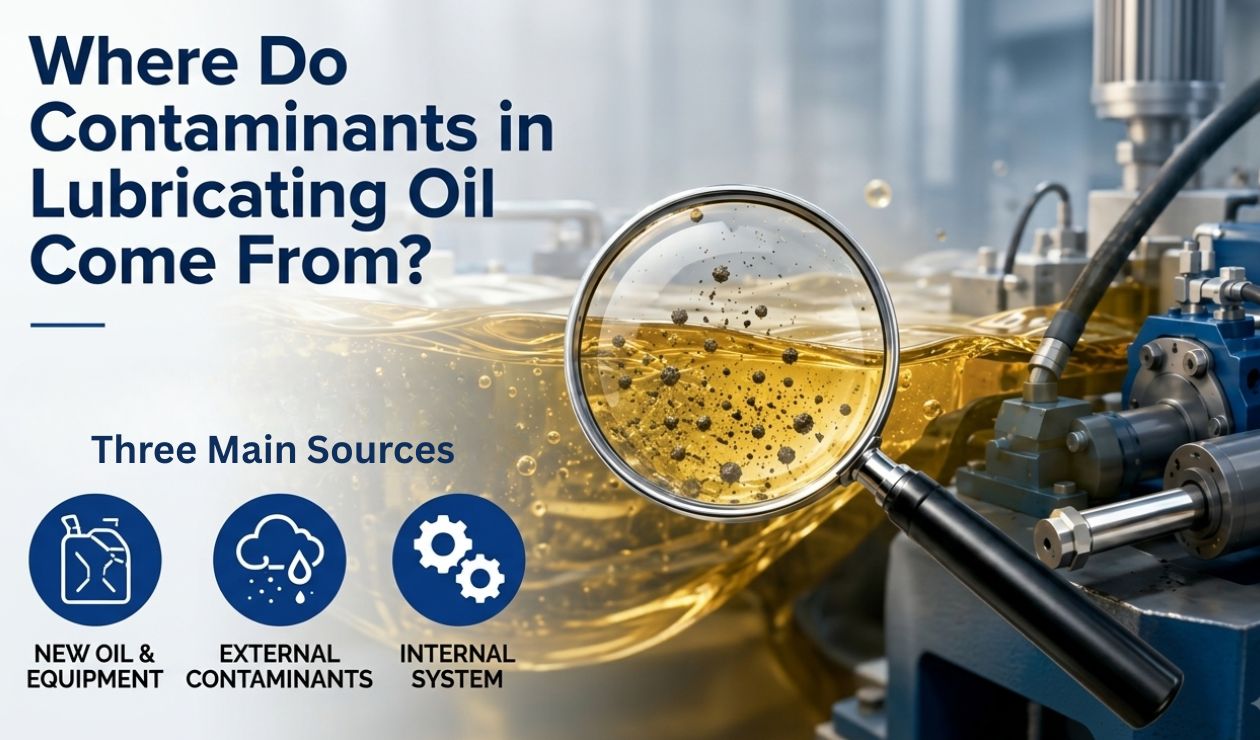
Lubricating oil contamination mainly comes from three sources: new oil and transfer equipment, external contaminants, and contaminants generated inside the system. Identifying these sources helps maintain oil cleanliness, reduce component wear, and extend equipment life.
New oil is not necessarily clean oil. During storage and transfer, particles can enter through oil drums, pumps, hoses, and piping.
Before filling a hydraulic or lubrication system, filter the oil through a high-precision oil filtration cart. This helps remove particulate contamination before it enters the equipment.
External contaminants can enter through:
• Damaged or poorly sealed cylinder seals
• Residual contamination inside cylinders
• Dust and moisture entering through reservoir breathers
• Contamination left in piping after maintenance or inspection
Inspect seals regularly. Replace damaged sealing components promptly. Oil sampling and analysis can also help identify abnormal contamination and possible seal wear.
Protect reservoir breathers. Suitable isolation or desiccant breathers can reduce the entry of airborne particles and moisture. For critical systems, bladder or diaphragm isolation, or nitrogen blanketing, can provide additional protection.
Follow clean maintenance procedures. Clean the work area before opening the system, keep exposed oil ports covered or plugged, and avoid maintenance in dusty or windy environments. Use lint-free materials and prevent tools or foreign objects from entering the reservoir.
Contaminants can also be generated during normal operation. Common sources include:
Residual particles in reservoirs and piping
• Condensation caused by temperature changes
• Oil oxidation products
• Oxidation products around valves
• Wear particles from moving components
• Initial wear particles from pumps
These particles and other contaminants can increase oil cleanliness levels, accelerate component wear, and affect sensitive hydraulic and lubrication components.
Effective contamination control starts with a clean, thoroughly flushed system and continues throughout its service life.
A practical program should include:
• Filter new oil before filling.
• Keep reservoirs and oil ports properly sealed.
• Use suitable breathers to limit dust and moisture ingress.
• Maintain clean procedures during inspection and repair.
• Regularly sample and analyze the oil.
• Inspect or replace mechanical filter elements when contamination exceeds the target level.
• Use an online/offline oil purifier or filtration system when the existing filtration system cannot maintain the required oil cleanliness.
Preventing contamination is more effective than dealing with its consequences. Combining clean oil handling, contamination prevention, regular oil analysis, and effective filtration helps protect equipment, extend oil life, and reduce unplanned maintenance.
PREV: Phosphate Ester Fire-Resistant Oil How Acid Number and Resistivity Indicate Oil Condition
NEXT: No content

AITAI, founded in 2013, is a high-tech enterprise focused on TEL. As the strategic partner of 3R Group Japan, we provides ultra-precision purifiers, on-site solutions, and oil testing& analysis, Serving metallurgy, automobile, power, marine, petrochemical, and machinery industries.


Email:chunlianyang@aitaitech.com
Address: Room 1105, Building B, Aotekexing Science Park, Yuehai Street, Nanshan District, Shenzhen
|
|
 Lubrication Management Expert